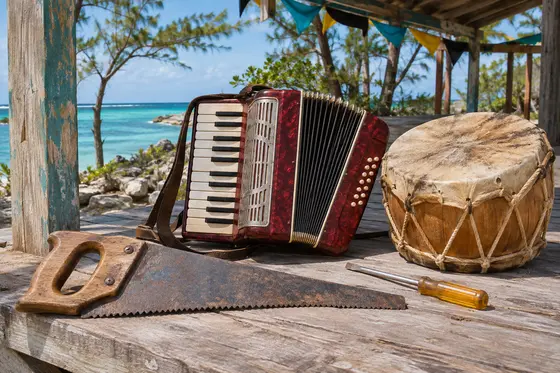
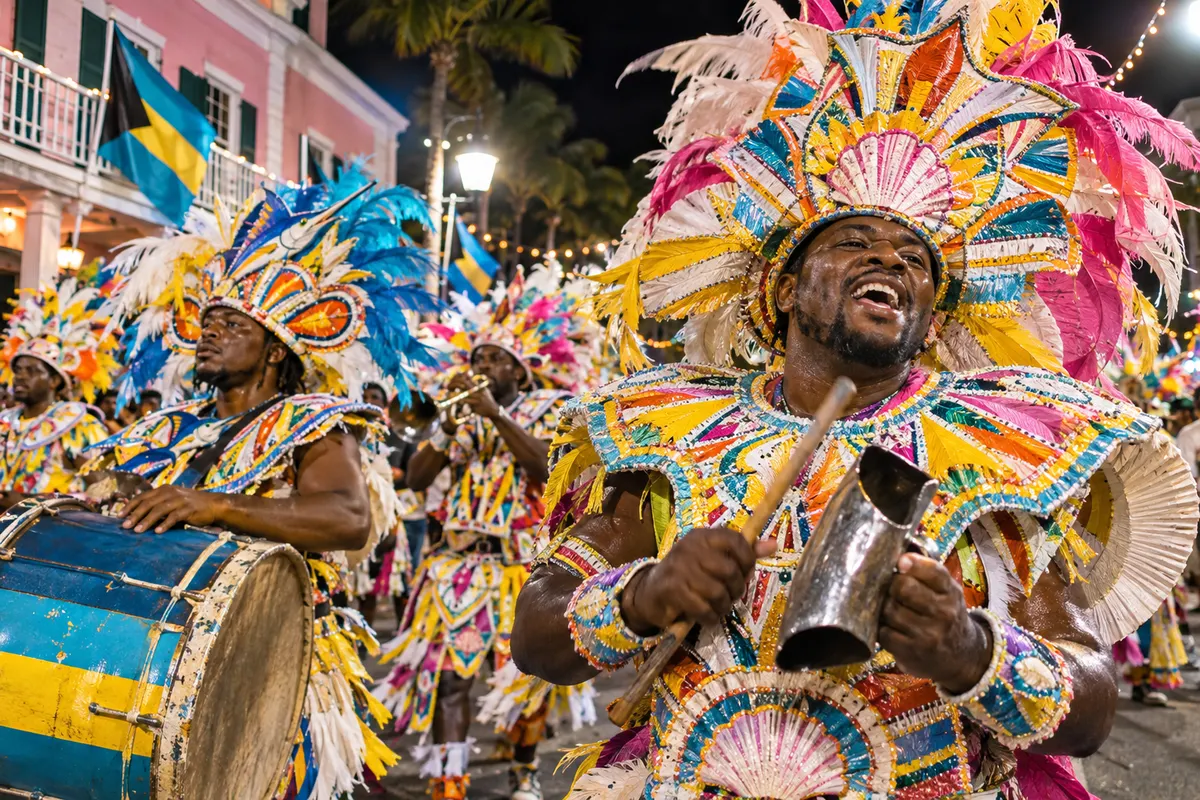
Junkanoo is easiest to understand through its sound. The beat begins with goatskin drums, then cowbells, whistles and brass instruments join in. In Nassau, groups of dancers and musicians sometimes spend hours making their way along Bay Street. A costume that takes months to finish might pass a spectator in a matter of seconds.
Where the tradition comes from
The precise beginnings of Junkanoo remain uncertain. One widely held explanation links it with celebrations held by enslaved Africans during the Christmas season. Temporary breaks from plantation labour gave people an opportunity to gather, make music and dance. Another tradition associates its name with a West African figure called John Canoe. Rather than settling on one neat origin story, it is worth remembering the different communities that passed the custom on.
In the twentieth century, the informal gatherings developed into highly organised competitions. Groups arrange their own music, choreography and costumes, often working in dedicated workshops. Paper, cardboard, glue, fabric and feathers are built into astonishingly elaborate pieces. Even the structure that supports a headpiece matters, since performers have to carry it along the parade route.
When and where to see it
The two major Nassau parades take place around Boxing Day, 26 December, and New Year's Day. Much of the action traditionally begins in the middle of the night. A seat near the route makes a considerable difference for anyone planning to stay until morning. Hotels and the official festival organisers can advise on ticket availability and that year's arrangements. Celebrations are held on other islands and during parts of the summer as well, although they do not necessarily follow the schedule of Nassau's events.
It can get crowded on the narrow streets. Arrange transport back to your accommodation in advance, bring a bottle of water, and remember that the street can feel quite cool when a breeze arrives before dawn. Ask before taking close-up photographs of performers outside the parade itself.
Beyond the parade
If your visit falls outside the Christmas season, there are smaller opportunities to learn about Junkanoo, including museums, studio visits and performances arranged by local cultural organisations. Educulture's museum in Nassau documents costumes and instruments; contact the museum before visiting. Watching a maker explain the hours of paper cutting and pasting changes the way the finished costumes look. Every design has people behind it, and the fierce pride of the competing groups is part of the fun.
For confirmed parade information, consult the Bahamas Ministry of Tourism's Junkanoo guide.
How to recognise a group's work
The large costume pieces are generally viewed as part of a presentation rather than separate artworks. Look for shared colours and design motifs, the way dancers move around the larger structures, and the relationship between musicians and the people carrying the costumes. Competitions involve judging, and individual groups take considerable pride in their results. The atmosphere changes as each group approaches. There may be a lull in the street followed by a wall of sound. If you cannot remain for the whole event, even an hour on the route gives a glimpse of the preparation behind it. Keep steps and entrances clear so that the competing groups can pass.
Inside a Junkanoo shack
For a parade group, the greater part of the year may be spent somewhere that the public seldom sees. The workshop is known as a Junkanoo shack. It is a place where designs are prepared, dimensions worked out and pieces assembled. Younger members learn alongside experienced costume makers, taking on jobs that suit their level of experience. The craft includes many rather ordinary tasks: tracing a pattern, cutting hundreds of paper shapes, sorting colours and repairing a piece that did not survive transportation. A costume made in this way can incorporate an enormous amount of handwork without looking handmade from the opposite side of the road. There are also people taking care of accounts, storage, supplies and the practical arrangements for the night. In its description of the Junkanoo tradition, UNESCO draws particular attention to the part played by these workshops and families in passing on skills between generations. The distinction between a festival and the people who sustain it is well worth keeping in mind.
Paper, colour and costumes in motion
When looking at a costume photograph, it is easy to concentrate on the spectacular size of the headdress. Up close, however, the method of arranging thousands of small pieces of material may be even more impressive. Layers of coloured paper can be folded, fringed and put together to produce patterns with depth and texture. Combinations of light and dark colours make shapes readable at a distance. Decorative trim and reflective surfaces catch the lights along the street. Costumes must also work for people in motion. A beautiful piece that restricts the wearer's vision or makes ordinary movement difficult will present quite different problems from a decoration that stays in one place. Look at the way a large shoulder piece moves when its wearer turns, and notice how the smaller costumes often use details from the larger designs. There is a great difference between an individual standing still for a photograph and the whole group approaching a corner of the route.
Following the parade as a musical performance
An audience unfamiliar with the competition might initially hear only a great volume of noise. After a while, distinct parts become easier to identify. A drum beat gives the music weight; a row of cowbells introduces a sharper pattern that cuts through the surrounding sound. Whistles and horns help create short accents, announcements and changes of phrase. When the brass players introduce a tune, the familiar notes give spectators something to recognise in the middle of the percussion. Some phrases are repeated until the dancers have completed a movement or the group reaches the next stretch of street. Other moments call for a greater change of pace. Watching the feet of the dancers can be a particularly useful way to follow the beat. People nearby may call out a group's name, respond to a melody or join the dancing from their seats. The audience does not simply listen to a piece of music; its reaction has become part of the occasion.
The smaller groups and the next generation
Although the biggest groups tend to attract the most attention, a great deal of the tradition exists at a more modest scale. A child taking part for the first time has little concern with huge elaborate sets or the number of spectators following a group. Learning the music, practising a few steps and being given responsibility for a small section of decoration can be an important experience in itself. Schools participate in Junior Junkanoo, allowing students to perform with their classmates and see how a creative project comes together. The costumes, musicians and themes of school groups give an entirely different impression of the parade from the largest adult competitions. Look for these activities when reading about Bahamian culture. They also explain why an event associated with a few nights in December cannot be separated from arts education, summer activities and home life. The adults who cut paper or teach a rhythm are often continuing skills they first acquired as children.
Choosing a place to watch in Nassau
A street parade presents decisions that would not normally arise during a theatre performance. How close will the audience be to the performers? Is there room to leave and return to a seat? Can an older member of the family rest somewhere, and will the children be awake and comfortable when the parade actually takes place? Discuss these details with your accommodation before committing to a ticket. Sitting near the main action can be a good option for those who want to see the costume details; standing farther from the most crowded areas may suit people more interested in enjoying the atmosphere for a short while. Carry only what you need and keep valuables secure. Consider ear protection for children or anybody especially sensitive to loud sounds. Allow more time than usual to walk a short distance if streets are closed. On the following day, avoid making ambitious excursion plans, particularly if everyone will be returning to bed after a night on Bay Street. A holiday that leaves room for rest offers a much better opportunity to appreciate the celebration.