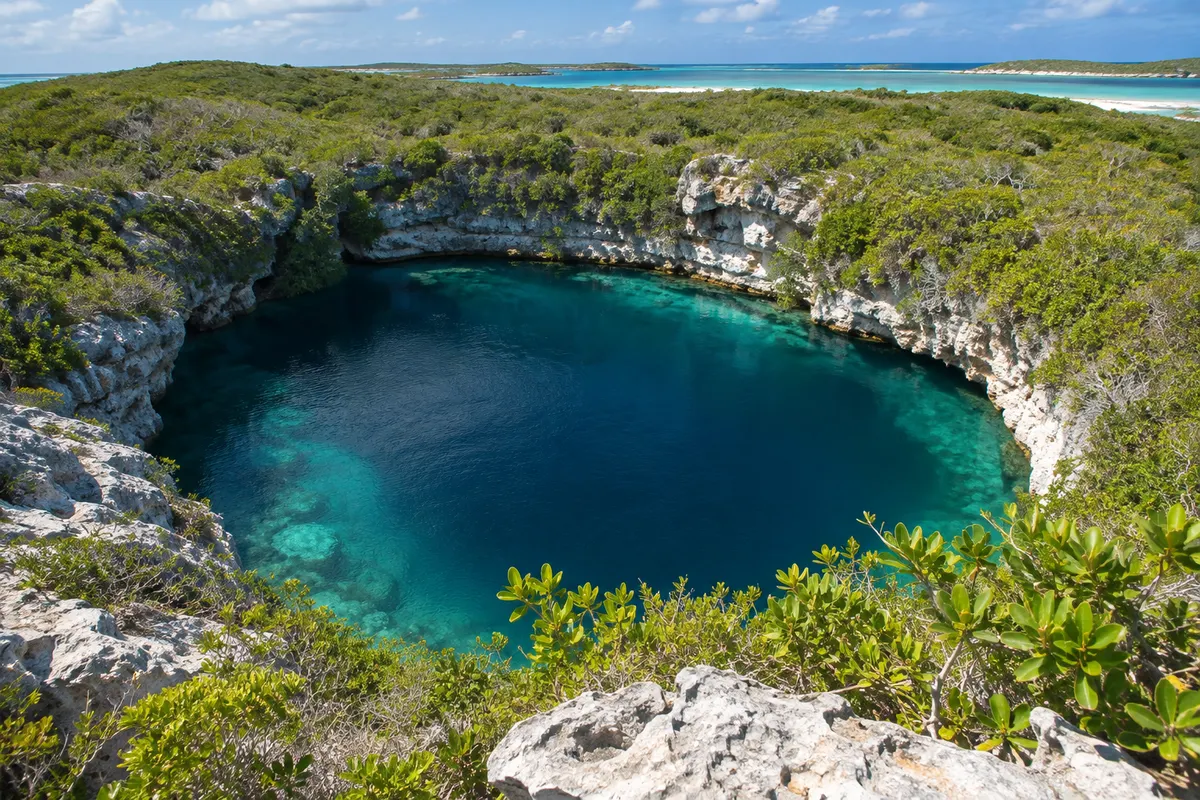
The islands of the Bahamas are formed largely from limestone, and this porous rock helps explain one of the country's most distinctive geological features. A blue hole can appear as a dark opening amid brilliantly pale shallows or as a surprisingly deep pool in the middle of dry scrubland.
How blue holes develop
Over long periods, water passing through soluble limestone enlarges cracks and cavities. Sea-level changes alter the environment within the rock, and some cave roofs eventually collapse. The result can be a sinkhole or a flooded cave system. Depending on the location, a blue hole may contain freshwater, seawater or layers of both. Darkness makes a deep opening appear much bluer than the sandy shallows around it.
Andros and Long Island
Andros is particularly rich in inland blue holes, where a visitor can observe limestone landscapes and forest habitats. Some sites are protected and can be viewed from approved paths. On Long Island, Dean's Blue Hole is located near the coast, with a striking change in colour from the surrounding waters. Other islands have smaller sinkholes, many of which are inaccessible or unsuitable for casual swimming.
Look without taking risks
The beauty of the surface gives little indication of the complexities underneath. Cave entrances may have strong water movement and confusing passages. Ordinary swimming or open-water diving experience does not prepare someone for an overhead environment. Stay within supervised swimming areas and never attempt to enter caves or descend into a hole without specialised professional training and appropriate arrangements.
There are good reasons to keep the sites undisturbed beyond personal safety. Their waters and surrounding habitats can support rare organisms and hold clues to the geological and environmental history of the islands. Do not introduce litter, remove rocks or disturb protected vegetation. Contact the Bahamas National Trust for information about public park access and choose an established guide if you want to visit lesser-known sites.
The water below the ground
The limestone islands can contain freshwater lenses floating above denser salt water. In certain caves or sinkholes, differences in salinity and other water properties create distinct layers. This is one reason that blue holes interest geologists and biologists. From the shore, such subtle features are not always visible. A park guide may be able to explain their importance using the shape of the land and the location of the openings. Some parks close for maintenance or conservation work, so verify that your intended site is open before making a special journey.
What a blue hole tells us about old coastlines
From an aircraft, parts of the Bahamas look like a collection of thin strips of land floating above a pale submerged platform. The visible land is only one portion of the limestone beneath the archipelago. During colder periods in the geological past, much of today's shallow marine terrain stood above sea level. Rain and groundwater circulated through cracks in the exposed carbonate rock. Their long-term effect was to develop a landscape full of underground chambers.
When sea levels rose again, some of those chambers filled with water. A site that is inland today may therefore contain features created under environmental conditions very different from the ones we see now. Stalactites and stalagmites in flooded caves, for example, could have grown at times when those spaces contained air. Their existence helps explain why the apparently simple openings at the surface are valuable geological records. There is a relationship between the clear shallows, the rocky landscape and the dark water that a visitor can appreciate without needing to examine the hidden passages themselves.
Visiting Blue Holes National Park on Andros
The Blue Holes National Park in northern Andros was designated in 2002. Its protected area includes a substantial tract of woodland surrounding the geological features. Visitors may associate Andros chiefly with marine activities, but these inland landscapes have a very different character. Pine woods open into patches of denser broadleaf vegetation, and close to the holes the rocky land meets particularly vivid water. The park gives you an opportunity to look at the relationship between the forests and the freshwater habitats.
Captain Bill's Blue Hole is a known feature of the area. Rather than assuming that access is guaranteed because there are familiar photographs online, contact the managing organisation and plan around the current status of the park. A closure may be temporary, seasonal or connected with work on visitor facilities. If an excursion is available, ask whether it focuses on geology, woodland wildlife or both. This is also sensible country to visit with appropriate footwear, since the limestone surfaces are irregular even on dry days.
Dean's on Long Island and the caves of Grand Bahama
At Dean's Blue Hole, the surrounding shoreline helps make the phenomenon visible. A traveller on dry land can see the contrast between the edge of a light-coloured lagoon and the much darker water at the opening. Rocky slopes enclose much of the site. The striking landscape has also brought it to international attention through the sport of competitive freediving. Watching a competition or reading about elite athletes is quite different from trying the sport. Their activities depend on extensive training, safety teams and regulated arrangements.
There is a different kind of land visit at Lucayan National Park on Grand Bahama. Its caves lie close to other significant habitats, including the mangroves of Gold Rock Creek. Some of the underground terrain can be interpreted from visitor platforms rather than via the water. On this island it makes sense to combine the study of geology with a walk through coastal vegetation. Verify the condition of the paths with the park manager and respect any barriers restricting access.
A world for researchers rather than collectors
Dark underground waters support organisms adapted to an environment without the light on which terrestrial plants depend. One reason biologists find the Bahamian cave systems interesting is the variation between their individual habitats. A creature that appears small and insignificant to a casual observer may belong to a remarkably specialised local population. Scientists can use carefully documented observations to understand how organisms survive in different conditions.
Geologists and archaeologists also study cave sediments and remains that may have been preserved below ground. The material can tell them about events on the islands over long periods. Disturbing deposits removes evidence from its original context. Taking a sample home because the rock looked unusual, even from a seemingly dry part of a protected site, is a poor way of appreciating the place. A photograph or a drawing of the surrounding land will retain more of the story than a loose piece of stone. Formal research requires permission and an understanding of the environment that ordinary sightseeing does not.
Fitting blue holes into a longer holiday
The best island to choose depends on the rest of your plans. On Andros, a geological outing can be included alongside visits to forest, mangrove and coastal habitats. Long Island appeals to visitors interested in a leisurely drive between widely spaced settlements and long stretches of beach. Grand Bahama offers another combination of nature areas and the practical conveniences of Freeport. Travelling to all three solely to compare the holes is possible to imagine, but domestic transport and weather can make a crowded itinerary unnecessarily awkward.
Start by selecting an island you would also enjoy if a particular attraction is unavailable. Ask a locally based operator to explain the terrain, access, accessibility and services at any site before you set out. Keep the day flexible so you can see the location from approved viewpoints and spend the remaining time in another part of the island. A blue hole makes much more sense when placed within the larger Bahamian landscape, with its porous rocks, delicate freshwater supplies and apparently immense stretches of shallow ocean.