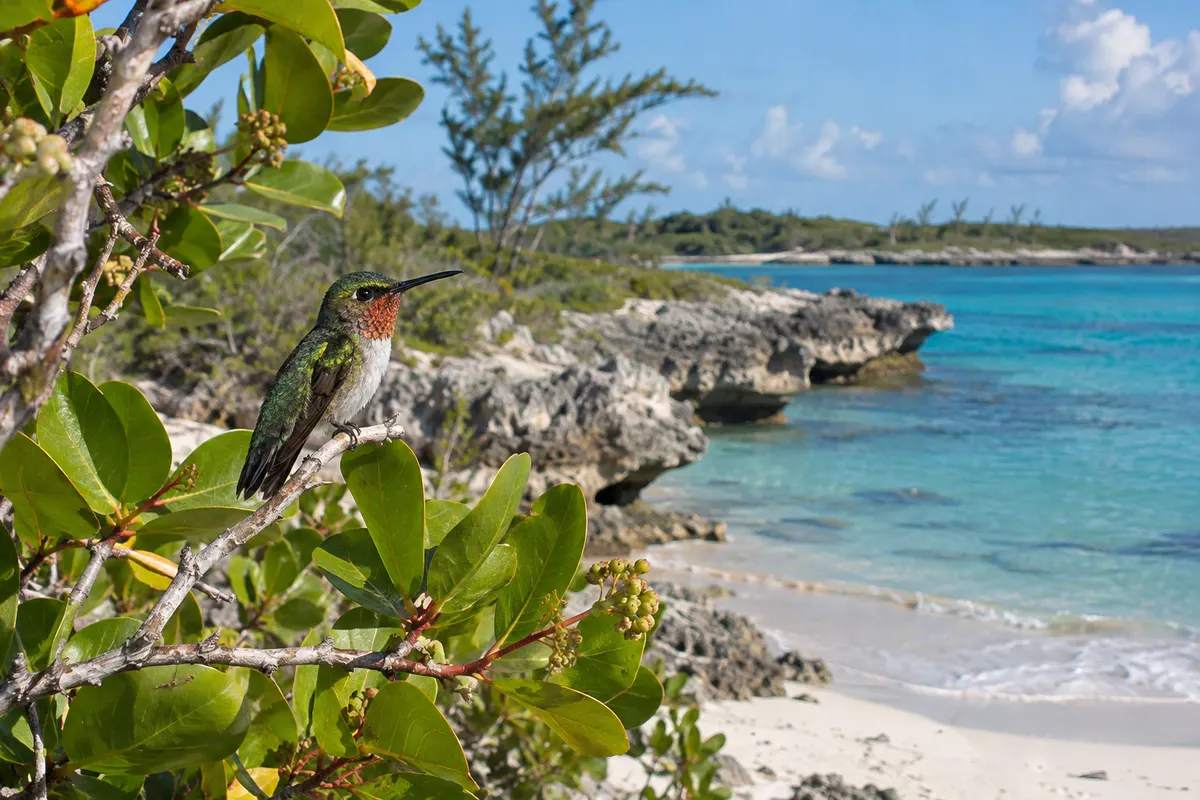
Not every memorable Bahamian wildlife encounter takes place in the sea. On an early morning walk, the calls of birds come from gardens and patches of scrub. A little farther away, salt ponds, tidal creeks and pine forests support quite different communities. Birdwatching fits naturally into an ordinary island holiday because it can start outside your room.
A few habitats to explore
The wetlands of Great Inagua are known for Caribbean flamingos, which may be seen at a distance in the shallow saline water. In the northern islands, pine forests and scrub provide habitat for birds adapted to wooded areas. Along beaches and sandbars, look for shorebirds feeding at the edge of falling tides. Many species have seasonal patterns, and different birds may be present on the same site several months apart.
The Bahamas also has endemic species and distinctive island populations. An up-to-date regional field guide or reputable birdwatching resource will help with identification, especially for small birds that look similar in poor light.
Watching without disturbing
Binoculars and patience are much more useful than approaching a bird closely. Stay on designated paths in protected areas, keep a generous distance from nesting sites, and do not use recorded calls to attract wildlife unless doing so is specifically approved within a responsible organised activity. Birds resting on exposed beaches can be easily disturbed by visitors, dogs and boats.
Planning your morning
Set out early, before the heat builds. A guided trip is worthwhile on an unfamiliar island because a local birdwatcher will know the appropriate access points and the places where a species may be found without harassment. Carry water, sun protection and suitable shoes. In the southern islands, book transport and park access in advance. If a bird is too far away to see clearly, enjoy the rest of the landscape rather than chasing a better view. The Bahamas National Trust is a useful starting point for protected habitats.
A notebook for the holiday
Keep a note of the island, the habitat and the date when you see a bird. Even if you cannot identify it, details such as its size, bill shape, behaviour and the type of vegetation are useful when you look it up later. A photograph taken from a comfortable viewing distance may help. A notebook also creates a useful account of places you visited. Don't trespass to add another species to the list or publish the exact locations of sensitive nesting sites. Share observations in a way that puts the birds' welfare first.
Great Inagua's distinctive salt ponds
The southernmost part of the Bahamas has a drier climate and a landscape that may surprise visitors familiar with the woodland of the northern islands. Vast areas of Great Inagua consist of saline water and low scrub, alongside salt-industry ponds. The flamingos are conspicuous partly because the landscape around them is so open. Even when a group is too far away for the detail of individual feathers to be seen, the colours of the birds can provide a contrast against the water.
Flamingos feed on small organisms in these shallow saline environments. Unlike many birds seen briefly in flight, they can often be observed for some time as they move across the water. The protected area also supports less conspicuous birds, including the Inagua woodstar, a hummingbird associated with the island. Contact the managers of Inagua National Park to discuss suitable visitor arrangements rather than expecting all wetlands, including those near industrial operations, to be accessible. A knowledgeable guide will know where visits are appropriate and whether conditions permit them.
In the pine forests of Great Abaco
Pine woodland is a particularly interesting habitat to visit if you have already spent time beside salt ponds. The combination of tall trees, broad spaces between trunks and a variable understorey creates opportunities to see birds in motion as they travel between branches. The Abaco National Park protects an area of pine forest and broadleaf woodland. It was established in part because the native parrot population has an unusual way of breeding here: the birds use cavities at ground level rather than the elevated tree hollows associated with many parrots elsewhere.
The park is also home to birds with names reflecting their relationship with the islands, including the Bahama yellowthroat and Bahama warbler. The latter is associated with the northern pine woods. Its distribution is a reminder that bird species can be concentrated in a surprisingly small portion of an archipelago. Sizeable tracts of woodland are important because they provide habitat for much more than the individual species a visitor hopes to see. A guided forest walk also offers a chance to appreciate plants, insects and other features of this landscape.
Estuaries and gardens near Nassau
If you are staying on New Providence, plan a visit to one of the nature areas rather than assuming that you need to fly to another island. The Retreat Garden offers a change of scenery from the streets of Nassau and woodland birds may be found among its vegetation. Farther from the city centre, the tidal habitat at Bonefish Pond gives you opportunities to watch different kinds of birds in a more open environment. Harrold and Wilson Ponds are another area of local wetland.
The Bahamas National Trust birdwatching information is helpful when choosing an appropriate site and discovering the sorts of birds recorded there. On a garden outing, listen for movement within the foliage and watch for hummingbirds around blossoms. Along the edge of a wetland, take time to examine more distant birds searching for fish or smaller organisms. Check the current opening days and admission arrangements at each location. An hour at a single suitable site is often more productive than a rushed circuit of several parks.
The birds that cross the ocean
Not every species in the Bahamas remains on the islands all year. Some birds travel extraordinary distances between the places where they breed and spend the winter. From a conservation point of view, the islands can therefore be connected to much more distant habitats, even where the resident human communities have very different histories. When visiting from the United States or Canada, you might recognise the appearance of a shorebird despite seeing it in surroundings entirely unlike those at home.
The Joulter Cays lie north of Andros. Research and conservation work there highlighted the value of extensive tidal flats for wintering piping plovers, among other shorebirds. The importance of such places led to the designation of Joulter Cays National Park in 2015. Migratory birds often depend on suitable resting sites and enough time to replenish their energy reserves. Even apparently ordinary birds standing on exposed sand deserve plenty of space. Their need to feed or rest should come before your wish to photograph them.
Begin with shape and colour, not the name
Bird identification takes time because an individual's appearance may vary with age, sex, season and the direction from which light falls on it. At a coastal pond, begin by looking at the shape of a bird and how it moves. Herons tend to concentrate on the water in front of them, while smaller shorebirds may cover much of the wet sand in short bursts of activity. Long bills, narrow bills and stout short bills can be clues to the food they seek without being sufficient to identify the individual species.
On a woodland walk, you can use a similar approach. Look at whether a bird clings to tree trunks, searches for food among leaves or perches in the open before flying to catch something. Binoculars are usually enough for garden birds. A telescope may be valuable on a large pond where birds need to be viewed from afar. Practising with equipment before the holiday helps you enjoy the surroundings once you arrive. There is no requirement to identify every bird you see, and it is often better to spend several minutes studying one you can see clearly.