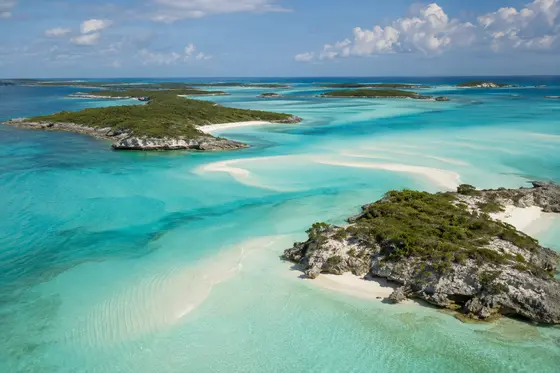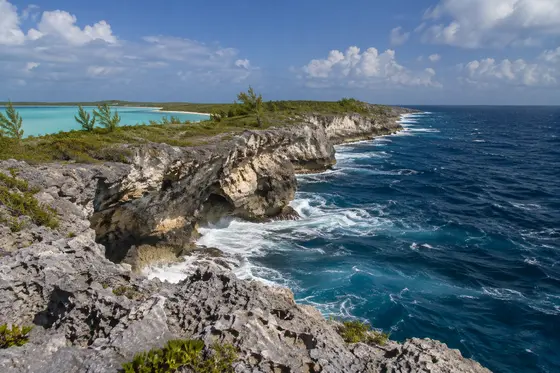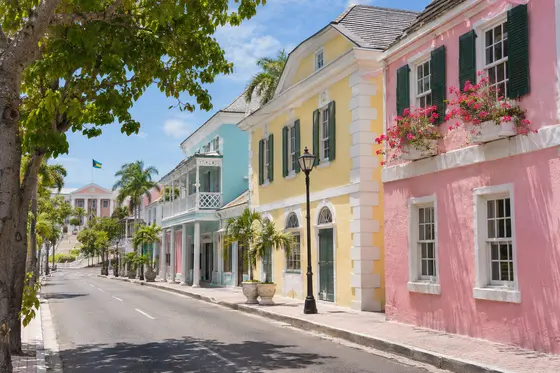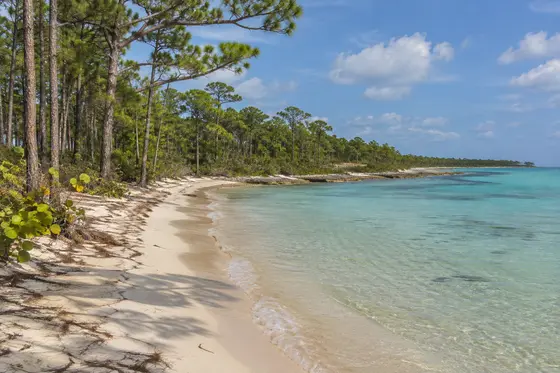
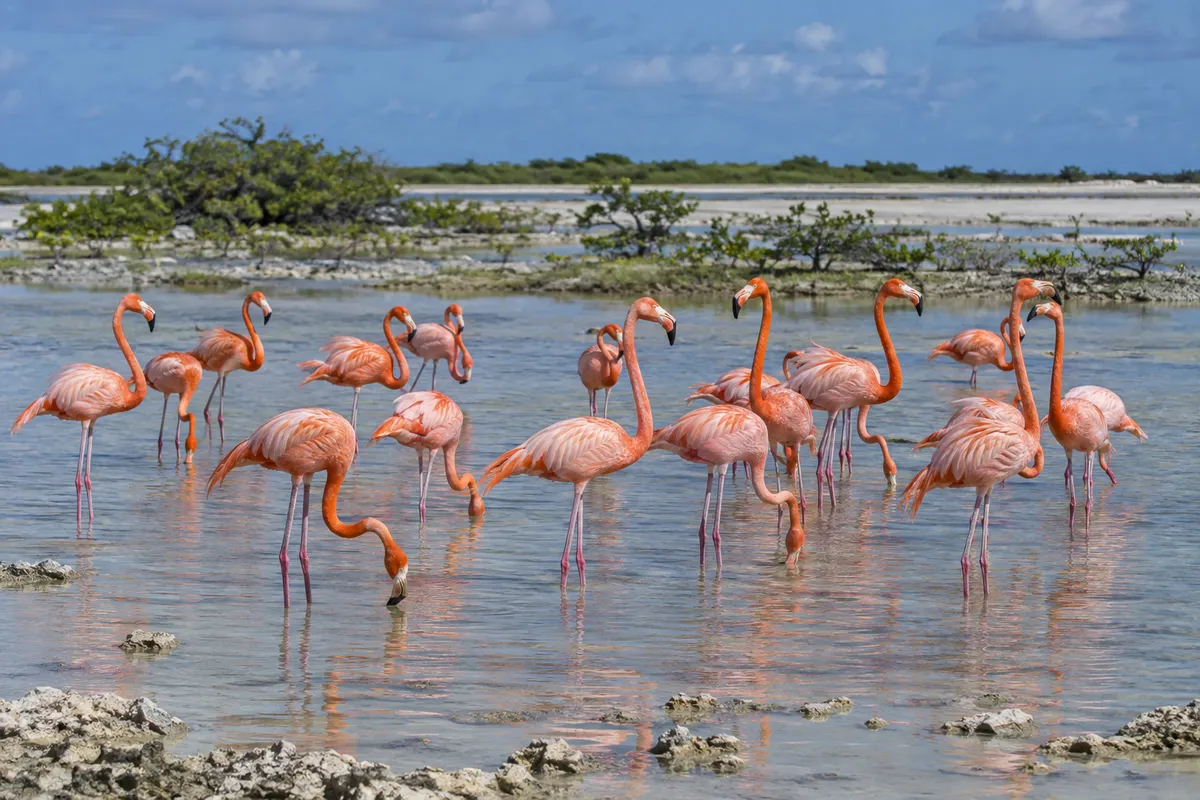
The dry landscape of Great Inagua contrasts with the green and turquoise scenes often used to represent the Bahamas. Large salt ponds, low scrub and open sky give the island an almost austere appearance. It is known for its remarkable Caribbean flamingo populations and the importance of its wetland habitats.
Matthew Town and the salt industry
Matthew Town is the island's principal settlement and a practical starting point for a visit. Salt production, which uses evaporation ponds, has played a major part in the local economy and landscape. Industrial areas should not be entered without permission. A local guide can explain which roads and viewpoints are accessible and how human activities and wildlife fit together on the island.
Seeing flamingos responsibly
Inagua National Park protects extensive areas of wetland used by flamingos and other birds. Large flocks are extraordinary to watch, especially from a distance when they move across the shallows together. Binoculars are more useful than trying to approach the birds for a close photograph. Noise, sudden movement and unnecessary disturbance are unwelcome in feeding or nesting areas.
Arrange access through the appropriate park authority or local guide. Conditions vary and some tracks are remote. Do not attempt to drive across salt flats or into closed areas. Bring water, suitable shade and any equipment you need for a long outing.
Travel considerations
Great Inagua is a long way from Nassau and the busier northern islands. Services and flights can be infrequent, so arrange lodging, transport and onward travel first. It is particularly rewarding for people interested in birds, wetlands or the island's working landscape. This is a destination where a few well-planned outings with an experienced guide will tell you more than a hurried succession of stops. Consult the Bahamas National Trust for park information.
More than flamingos
The salt ponds may receive most of the attention, but the surrounding ecosystem includes mangrove habitats, dry shrubland and shoreline used by a range of birds. On a visit, ask your guide about the changes in landscape that occur as you move between Matthew Town, open salt country and the coast. A distant flock of flamingos can be the start of the outing, rather than its sole purpose. The island's flatness and broad horizon make it easy to underestimate distances. Arrange transport with someone who knows which areas are suitable to visit and bring enough water for the day.
A southern island with a different climate
Great Inagua is among the largest islands in the Bahamas, yet the number of residents is small in relation to its size. Most of the population lives in or around Matthew Town. To the north and east lies an extensive area of open water, salt flats and dry vegetation. The low relief leaves the landscape especially exposed to both sunlight and wind, and standing on a flat shore it can be surprisingly difficult to judge just how far away something on the horizon might be.
Salt production is particularly suited to a place where evaporation is high. Sun and wind concentrate seawater until it reaches conditions in which salt crystals can form. In a commercial operation the different ponds have different purposes, and the water may change its appearance as the salt concentration increases. Shallow water can reflect a remarkably bright sky, while some ponds acquire colour from the organisms living there.
These industrial ponds should be viewed only from recognised roads and authorised locations. Moving machinery, restricted areas and deep channels may be impossible to distinguish from a distance. A guide who has spent time in the area can explain how salt production fits into the working life of the island, and why the wetlands are so important to its wildlife.
The remarkable recovery of a national bird
Great Inagua's flamingo colony is one of the notable conservation stories of the Caribbean. By the middle of the twentieth century, hunting and disturbance had drastically reduced the population. Protection of the breeding grounds was essential if the birds were to become numerous again.
The Bahamas National Trust dates the establishment of Inagua National Park to 1965. The protected wetland system has since become internationally recognised and is included on the Ramsar list of wetlands of international importance. By protecting a large area in which birds could feed, rest and breed, the park helped bring the flamingo population back from a very precarious position.
The West Indian flamingo is the national bird of the Bahamas. Its presence in large numbers on Inagua is significant far beyond the island itself. Birds can move between islands, and protecting breeding habitat in one place contributes to the survival of a much wider population.
Numbers given in visitor guides are estimates and may be associated with different survey dates. There is no guarantee that a particular pool will be full of birds on the day you arrive. They move to feeding areas according to water levels and the availability of food. The best person to ask about recent sightings is someone working with or familiar with the park at the time of your visit.
Why flamingos behave and look the way they do
From afar, a busy flock may look like an indistinct patch of pale rose colour, but it becomes fascinating when you look through binoculars. Some birds stand still or preen, while others feed with their heads angled down so that their curved beaks can sift tiny food particles from the water. There is often a noticeable difference between the colour of adult birds and immature ones.
As the Smithsonian's National Zoo explains, the characteristic pink and orange colours in their feathers originate in their food. Pigments called carotenoids are present in the algae and small animals consumed by flamingos. The birds process the pigments as they grow their feathers. Young chicks, by contrast, begin life with considerably duller plumage.
Breeding colonies are particularly sensitive to human disturbance. Flamingos make nests from mud and normally lay a single egg on top. A person moving closer for a photograph may frighten many birds at once. Keep to the distance your guide specifies rather than making your presence known in the hope of seeing the birds fly. Many interesting behaviours take place when the flock is undisturbed, and the birds may settle into their routine while you watch quietly.
Little Inagua and the Union Creek habitat
Great Inagua is only one part of the local island geography. Little Inagua lies to the northeast and has no permanent settlement. The Bahamas National Trust manages three distinct protected areas in Inagua: Inagua National Park, Little Inagua National Park and Union Creek Reserve. Each protects a different combination of marine and terrestrial habitats.
Union Creek Reserve is especially associated with its marine turtle habitat. Mangroves around the tidal creek provide sheltered waters and complicated habitats where many aquatic organisms live. Little Inagua, meanwhile, has an extensive protected marine area and habitat of importance to sea turtles and seabirds. These reserves are not simply additional attractions to add to the same afternoon's sightseeing list. Access is specialised, and a conservation area may have stricter limitations than a developed visitor facility.
Ask about the possibilities for a visit before committing to boat travel, and always obtain the necessary approval through the park authorities. Most visitors can learn a great deal about these environments through a land-based guided outing on Great Inagua, or by asking about wildlife projects. Do not approach untouched beaches, nesting areas or rocks occupied by resting birds simply because they appear deserted.
Making time for Matthew Town
The lighthouse in Matthew Town dates from the nineteenth century. Its white stone tower is an important landmark on a coast that sailors have approached for generations. The lighthouse is a piece of working maritime heritage, so ask about authorised visits rather than expecting it to function as a regular museum. A walk nearby may be an opportunity to observe the harbour and coastal buildings even if the tower itself is not accessible.
For a visit lasting several days, leave one day free from a substantial excursion. Early mornings may suit birding, while the middle of the day can provide an opportunity for rest and a meal out of the sun. Photographers will find the shifting reflections in the shallows and the simple shapes of Matthew Town an interesting contrast with the more familiar Bahamian scenes farther north. Inagua's appeal lies as much in its gentle rhythm, salt-bright horizons and hardworking community as in a single encounter with its famous birds.