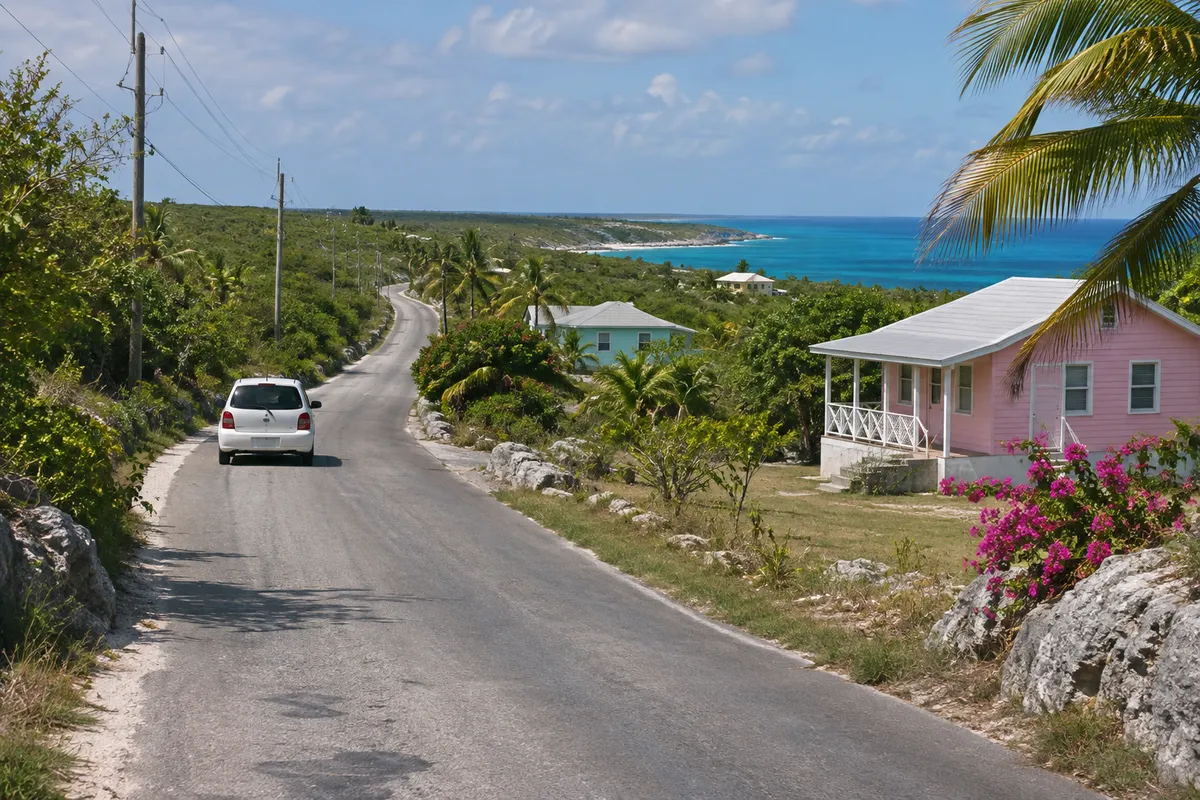
On a long island like Eleuthera or Long Island, driving is often part of the holiday. The settlements sit along narrow roads, with beaches or small harbours just beyond the next bend. A car makes it possible to visit places that are difficult to reach by taxi, but distances and road conditions need to be taken seriously.
Before collecting a car
The Bahamas drives on the left. Visitors used to the right should practise the rhythm of turning and looking both ways before setting off. Ask the rental company what documents, insurance and deposit are required and whether your licence is acceptable. Check the vehicle for existing damage and learn how to contact the company if you have a problem. Some rentals have restrictions on unpaved roads.
Roads on small islands vary in quality. Expect uneven surfaces, potholes, pedestrian traffic and occasional animals near villages. A lower speed makes it easier to enjoy the scenery and react to unexpected conditions. Avoid setting out on unfamiliar narrow lanes after dark if you can help it.
Plan a short route rather than a long checklist
On Eleuthera, choose one part of the island for the day and use daylight well. The contrast between the Atlantic coast and the shallower western side is worth seeing, but access tracks can be rough. At the Glass Window Bridge, heed local warnings about waves and don't stop where you would obstruct traffic. Take advice from people who know the roads before exploring an isolated beach.
Fuel stops may be widely spaced. Keep a reasonable reserve, carry drinking water and save a map for offline use. Avoid relying on one mobile signal for all your directions. Ask a host where you can park and whether the route passes through private land.
Making the most of the drive
Leave time for a roadside bakery or fish market, and avoid rushing through a settlement to get to the next viewpoint. A road trip is especially rewarding in the early morning, before the heat builds. On compact cays such as Harbour Island, walking or a locally hired golf cart may be more sensible than a standard rental car. Apply the same care to rental agreements and road rules there.
Finding a place to stop
Before driving, ask about a couple of places where a visitor can park and approach the coast without crossing private land. Access points can be easy to miss, particularly where the road runs through scrub or behind houses. A road marked on a map may become a track, and a track that is passable in dry weather may not be suitable after rain. If there is any uncertainty, turn back and choose another destination rather than risking damage to the car or landscape. The same principle applies to a late afternoon drive: leave yourself time to return before dark.
Which vehicle suits the route?
Before comparing rental rates, describe the actual journey you have in mind. A compact car may work well if most driving is along the main paved road and between established towns. Bigger vehicles can be more comfortable for a group with a cooler and beach bags, although that does not mean they are suitable for every dirt track. Four-wheel drive is not permission to use a beach as a road. Ask the rental company which surfaces and areas are allowed under the agreement and which are excluded. The answer is much more useful than a general claim that the car is suitable for island driving.
Find out where you must collect and leave the vehicle, how to pay for additional drivers and what happens if a replacement is needed. Confirm the transmission, especially if you are unfamiliar with driving on the left and would prefer automatic gears. Check how the spare wheel or tyre assistance is arranged, whether the warning lights work and whether the vehicle has adequate air conditioning. Take the information the owner provides about local road conditions seriously. An inexpensive car that has to be returned halfway through the holiday because it is unsuitable for the route is rarely a bargain.
Building a route round a settlement
Place a town or village at the centre of a day's plan. It gives you a place to find a meal, ask about the road ahead and make a decision about conditions on the coast. On Eleuthera, for example, visitors based near Governor's Harbour might concentrate on central beaches and nearby settlements on one day. The trip to the island's northern attractions can be reserved for another day. Farther south, Rock Sound offers the inland Ocean Hole, a feature with quite a different character from the open beaches. Look at the Eleuthera and Harbour Island tourism guide for a sense of the island's geography before planning excursions.
Choose a route that allows a cut-off point. If you reach a junction later than you expected, you need not continue towards the final stop. That will be easier to accept if the first stop was an enjoyable place in its own right. Be conscious of how different beaches sit along the road. Access to the coast often means turning off the main route; returning to it after every visit naturally increases the day's mileage.
A different example on Long Island
On Long Island, destinations towards the northern tip and those around Clarence Town have quite different settings. Visitors who base themselves close to the middle can explore in either direction without planning to cover both ends in one day. A northern outing might be concerned with views of the banks and quiet beaches. A trip towards Clarence Town gives the opportunity to look at the settlement's twin-towered churches and combine architecture with a meal near the harbour. The Long Island visitor guide offers more details on places of interest.
Dean's Blue Hole is another striking feature in the southern part of the island. It is a site associated with experienced free divers, but casual visitors can appreciate the unusual landscape without attempting to enter the deep opening. Its abrupt depth, the condition of the sea and the capabilities of the people in your group are matters for careful consideration. Have a conversation with a professional guide about suitable activities if you particularly want to explore the water.
The island's quiet stretches can feel remote. Return to familiar roads while there is good light and choose a convenient point to eat or obtain drinking water before starting home.
Small details that make a day easier
A passenger can take responsibility for the route while the driver concentrates on the road. Load the next stop before setting out and keep a list of place names for the sections where a map will not load. A photograph of a sign at a junction can help identify the correct turning for the trip back, but the driver should not take it. Put wet towels away from the passenger seats in a suitable waterproof bag so the interior can stay reasonably clean. An old towel or mat may be useful when changing shoes after a beach visit.
Plan how to obtain lunch and keep a modest reserve of bottled or otherwise safe drinking water. A quiet island restaurant might prepare food to order, so ask when it opens and how much time you should allow. If you find a place that is closed, avoid pushing a long drive into the afternoon just to reach something at the end of the island. Check for a nearer alternative. Small shops may close on Sundays or public holidays, and the exact arrangements are best established locally rather than copied from old online listings.
Courtesy on roads through residential areas
The main road through a village is also where residents go to school, collect groceries, visit neighbours and head to the fishing dock. Slow down well before a built-up area and give space to walkers, cyclists and vehicles entering from side roads. Avoid stopping abruptly to look at a house or to photograph someone at work. Find a place where stopping is safe and ask before taking close photographs on someone's property.
Take particular care around unfamiliar animals and do not disturb them with the horn. If somebody following you is trying to make progress, wait for a safe legal place rather than becoming anxious about the vehicle behind you. Keep music and conversation within the car at a reasonable volume; quiet beaches and settlements are not organised entertainment venues. A little courtesy usually makes the place more pleasant for everyone. At the end of the day, remove all litter from the vehicle, refuel according to the rental agreement and leave adequate time for a final inspection before heading to the airport or ferry.